
Definition – TREATISE:
A systematic exposition or argument in writing including a methodical discussion of the facts and principles involved and conclusions reached.
– Merriam Webster

Constituent Engagement is an essential aspect of a pluralistic, inclusive, democratic society.
This Treatise will provide the context for a methodical discussion of Constituent Engagement and of the facts and principles involved in fulfilling the vision of a democratic society.
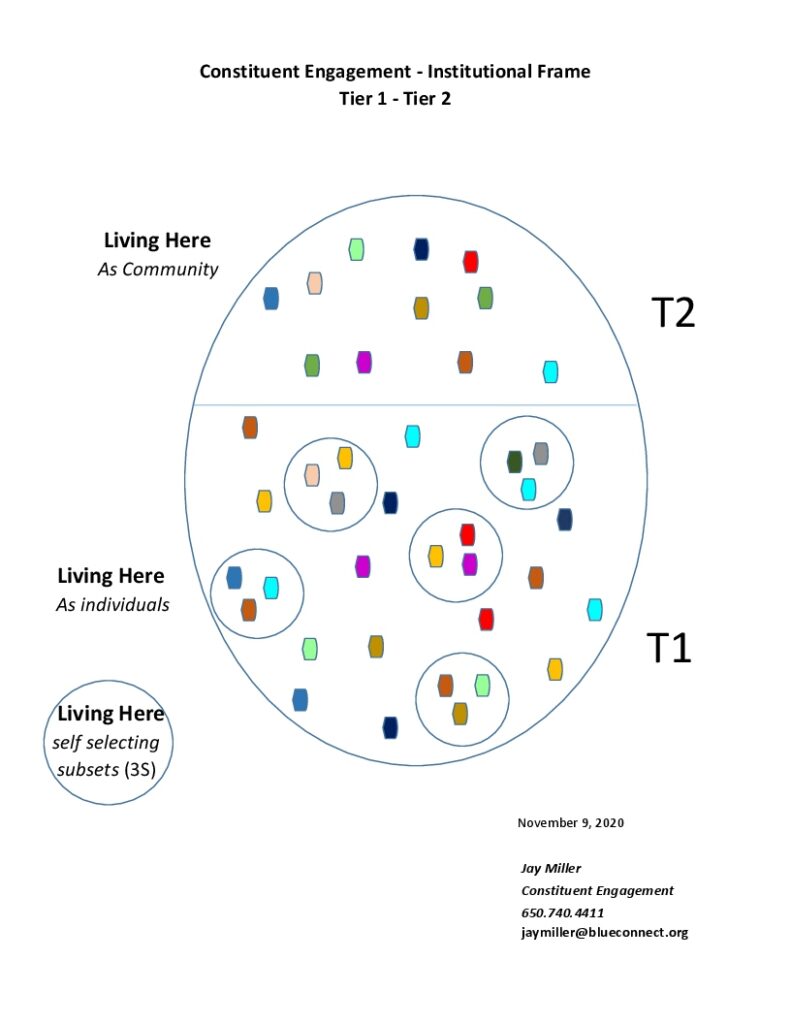
As I begin this web based continuation of the process of writing this Treatise, I will present a number of items which have developed in the process of my exploration of Constituent Engagement. This includes, as a new focus, advancing the “facts and principles” of SpecturmEngagment, as I am coming to understand its fundamental aspect of that study.
As with most studies, these sections have developed individually as part of the emerging process which will result in the final content and order of the Treatise.
I
SpectrumEngagement
In a fully participatory democracy, every individual must be assured of clearly delineated guarantees of equal access and due process:
- Without barriers
- With incentives
We The People – All The People is predicated on SpectrumEngagement, in which Constituent Engagement includes every individual, from every segment within society.
The statement of the Founders – “We The People” – was predicated on their premise that “We” (a) would not be inclusive and (b) would include, were necessary, barriers.
There were the named exclusions, and for those who were unnamed – the barriers. As a segment of individuals did gain inclusion, the modes of their exclusion shifted to barriers.
The law, in the Constitution and subsequent legislation, determined who were empowered and who were not. Over time, legal statues and cultural norms shifted, not always simultaneously. The practices of law enforcement and judicial systems preserved both:
- Legal statues
- Cultural norms
Statues and norms upheld a systemic separation, in a system in which separate was inherently unequal. The result has been centuries of:
- Systemic Bias
- Systemic Power Imbalance
- Systemic Identity Classification
2
2
A systemic reality of constituent ranking
In language usage which continues to go unnoticed, the use of “titles” defines identity classification, which includes:
- Gender – Women and Men classified as a separate category, and furthermore, the classification of a woman as married or not married, not delineated for men,
- Service to Community or Country – classified as a distinctive rank, excluding recognition of those of some rank, while not those of another rank,
- Earned Degrees (Medical and Academic) – classified as a distinctive degree, Dr. , excluding recondition of those of other degrees, RN, EMT, MLT, MSW, MFA, MBA, Assoc Profession, Instructor),
- Elected Representatives – classified as a distinctive official (Senator), without those officials of another title,
- Religion – classified as a distinctive category of ordination of some religions, excluding recognition of other religions and their clergy.
This applies in any circumstance where an individual’s Constituent Engagement or that of their subset – identity or self selecting – is unrecognized within the scope of the full spectrum of society.
This includes:
- Institutional, public or private, (a) inclusion of “title” in the gathering of information about constituents, members, clients or customers, or (b) communications which utilize “title” in any format unrelated to situation relevant and status inclusive professional acknowledgment,
- The use of language which reinforces the perspective of the scope of society which does not incorporate a paradigm which expresses the existence of the full spectrum of the individuals or subsets within that society,
- Infrastructure components in the universal realm of society, not related to relevant criteria, which, by language or practice, present boundaries which are governed in such a way as to require individuals, or subsets, to have a “knowledge of passwords” or “granted status” in order to move freely within any region or sector of the society.
Accommodation Quotient: This relates to any situation which requires a level of personal accommodation for an individual based on (a) the specifics of their personal circumstance, (b) the dynamics fostered within the situation, and (c) the imbalance of relationship maintained within the interaction of any subsets.
3
Examining the open paths for engagement includes attention to concepts and infrastructure.
For leadership and constituents, it is essential to have a clear understanding that engagement is intrinsic to navigating the nature of the society within which they live. This is the GPS which enables them to find the on ramp which leads to the Constituent Engagement highway – “There it is – my entrance to Constituent Engagement.” Successfully taking that on ramp requires two things, the command of a vehicle and the knowledge of the roadways.
The Supreme Court ruled that a corporation is a person. In so doing, they granted to a company, what was necessary for it to dedicate its established assets and infrastructure to engage in advancing its objectives as a “constituent” in society.
There is no parallel statement, confirmed by the Supreme Court, which grants to a person the same guarantee of the acquisition of the necessary assets and infrastructure to advance its engagement as a “constituent” in society.
There is no guarantee of the vehicle. Furthermore, for every individual, they are challenged to acquire the vehicle and find roadway.
There are a wide range of destinations necessary to for every individual to successfully gain and maintain the benefits of the community infrastructure and a safety net. For any individual, we now know that can extend to the needed benefits to withstand a covid pandemic and the plagues of inequity.
The Constituent Engagement highway was not a common path accessible for All The People. Yes, as barriers have been removed, and incentives increased, the potential presents itself for advancing We The People to All The People.
Our collective mandate and challenge now is how to insure that everyone has the platform which provides the bandwidth to secure both the vehicle and the GPS to fulfill the most basic aspect of Constituent Engagement?
4
A contemporary conundrum in answering this challenge of SpectrumEngagement.
It is the individual who has to get in the vehicle and take the on ramp. It is the collective that makes the keys available and insures the viable sign to the on ramps.
Voting is only one, historic, obvious component of Constituent Engagement. Voting only works as an expression of SpecturmEngagment when every individual is an informed voter – knowledgeable of the issues on the ballot and the process for voting.
The process of being educated on how to vote does not come in the election season, as lengthy as that has become, nor how much money is spent “educating” the constituents.
A constituent achieves the status of education through the ongoing process of Constituent Engagement. I am reminded of the term – continuity of relationship. It is through the continuity of engagement as a constituent that one successfully achieves Constituent Engagement.
This too is predicated on the individual access to their entitled vehicle and the access to the highway of democracy.
It is here that Regions and Sectors are an essential factor. Successfully gaining this full level of Constituent Engagement and achieving the necessary constituent education is a three way process –
- leadership engagement with constituents,
- constituents engagement with leadership
- constituent mutual engagement with each other
This is not a conceptual idea, it exists in a geographically definable reality. Air travel aside, each person walks their neighborhood and drives around the community. This is the terrain which defines the region which is the context for achieving constituent continuity of relationship, in each sector – government, education, human services, business, religion.
The region will be impacted by the state and the nation, but largely for the common good at the regional level. This is where people live out their lives, based on their immediately accessible resources and the common stock of mutual aid.
The real challenge is in the success in raises the human condition on a day to day basis, which shifts the election to the actual tuning the common good.
This comes through the realization of full Constituent Enagement, by Regions and by Sectors, of the people they contain.
5
A village and Constituent Engagement.
“It takes a village to raise a child: seems to be current conventional wisdom that
Reality: “It takes the people of a village to raise a child.”
Reality: “It takes the people to raise a village.”
That would be its affirmation and ongoing preservation.
A village is usually a geographic subset within a city. These subsets may be urban, suburban or rural.
Reality: “The village is not a self-selecting subset, it is a subset of the people in the designated geography.”
The village is probably something that is recognized as between what is the neighborhood and that which is the city. There are portions of Regions which are not cities, but unincorporated portions of the county.
While there are people who proclaim, “It takes a village.” What is missing is the proclaim, “What is the village?”
If the village provides the infrastructure which sustains and is sustained by people,
“More than the people sustain a village, a village sustains the people.”
Or is it…
“More than a village sustains the people, the people sustain a village.”
If we are seeking a pluralistic, inclusive democratic society, where We The People is All The People, it is incumbent on All The People to know:
- The boundaries of their village,
- The people of their village,
- The leaders of their village – in each sector.
- What role they are called upon to provide within the village.
With all the infrastructure in today’s world, there is no public declaration of the boundaries, people and leaders of each village.
That declaration could be ever-resent as :
- A box on the front page of the press,
- On the homepage of each level of the government,
- At the entrance to every school,
- In the window of every business,
- In the bulletin of every congregation.
Reality: “Constituent Engagement” is as much a cliché
as “It takes a village raise a child.”
This website is dedicated to codifying Constituent Engagement – attaining a common vocabulary, establishing a working infrastructure, and fulfilling Spectrum Engagement.
6
It is essential where the vocabulary begins.
The title of the book by Eric Klinenberg suggests the pivotal phrase “Palaces For The People.” Eric identifies two key concepts which define the village:
1. Palaces
2. Infrastructure
There is one shift in Eric’s statement about Palaces which is critical to actually achieving the prerequisite Constituent Engagement. The places which he identifies as Palaces are clearly significant places for the people. They are the places where people gather. If it is the people who are the essential component in the affirmation and preservation of the village. Where they gather is a key starting point.
The critical difference comes with an addition to “Palaces for the people” becoming “Palaces of the people.”
People entering these Palaces is a natural occurrence. This is what makes them available for the less natural occurrence, the engagement of people with the realm of the village. That they engage with people within each Palace is an intrinsic part of what makes it a Palace. It is a place of distinction and they are there for a reason, The space fosters their mutual engagement. In most of the Palaces which fit that criteria and are therefore identified by Eric, the people in each Palace have some common purpose which bring them to the place and come common identity which cultivates their relationships.
In the quest for Constituent Engagement, there are benefits derived from Palace relationships. First, their presence enhances their personal goals. Second, they find a place of mutual engagement. They are noteworthy “Palaces of the People” because their infrastructure sustains them as they serve individuals with these two benefits for those people.
They do not serve the village until they are Palaces of the People. As Eric’s book successfully articulates, each of these Palaces is a free standing, cherished component in the life of the village for the participating individuals. What is lacking in the village of today is the mechanism, the designed infrastructure, to engage the full spectrum of the population in advancing the collective village.
The next phase is the transformation of the Palaces For The People into the Palaces Of The People. This is accomplished through the design of the infrastructure which is the scaffolding for the transformational paradigm which aggregates the people of the village on behalf of the common good.
7
The Palaces Of The People
The Essential Infrastructure
We have Eric’s Palaces Of The People. The infrastructure is what is lacking. What was inherent when the village was a village is gone. This is the case whether the village grew to a town, has been absorbed as a suburb in a metropolis or transitioned to any other evolving configuration. We can trace how villages grew to towns then cities. We understand what resulted in the formation of the suburbs. The rural countryside was consumed by expanding city boundaries or was relegated to a more formalized county domain.
All these variations emerged within a more complex governing infrastructure. These variations did not emerge with a parallel Constituent Engagement infrastructure. What was the village infrastructure which sustained Constituent Engagement became more ad hoc and complex with each advancing configuration.
Challenge #1 is achieving the infrastructure to translate “pockets of Palaces” to “regions of Palaces.”
Challenge #2 is achieving the infrastructure to aggregate the Palaces Of the People into regions Of the people.
Combined this will insure the long-sought magnitude of Constituent Engagement and insure SpectrumEngagement.
Challenge #1, begins with the enumeration in Eric’s book of the nature of Palaces. It is clear that reflections of the village Palaces are here today.
There are some coffee shops where the person behind the counter has your coffee and favorite doughnut on the counter by the time you cross the room from the front door. These are models for transforming other coffee shops to Palaces. The same with libraries, barber shops, congregations, etc.
This Treatise identifies the circumstances and calculates the infrastructure design, providing the necessary elements for transforming Palaces For The People to Palaces Of The People.